I have no talent, I am just the material for leeks "| EagleTrader trader Ren Jianxu's Five Years

Ren Jianxu has been doing business for five years.
Looking back at the past three years, what impressed him the most was not how much he earned, but how many times he went bankrupt.
I have been running out of stock for the past three years. When a sum of money comes in, it usually explodes within half a month, a month, or even a week
During that time, he also doubted whether he was not suitable for trading at all.
I stopped in the middle and wanted to leave, but in the end, I returned to the market.
The real change starts with changing the practice of "losing money and adding positions".
After no longer attempting to recover losses through larger positions, his trading gradually shifted from continuous losses to no loss, no win.
Subsequently, he spent about a year reorganizing his trading philosophy, strategy, and risk management approach, gradually forming a more suitable trading system for himself.
I don't have any talent, my personality is like a leek, the only key is the self that never gives up. "Ren Jianxu doesn't think he has come to where he is today through talent.
For him, these five years have been more like a process of constantly making mistakes, discovering problems, and gradually improving them.
Why still choose trading?
When asked why he chose trading, Ren Jianxu's answer is simple: he likes it and loves it.

I'm tired of my life being arranged clearly in real work, and it's all at once
Trading attracts him not only for the outcome, but also for his autonomous choice of pace of life.
Now, he has made trading his full-time career direction and is ready to continue, 'Doing good trading is enough for this life.'
However, full-time does not mean frequent operations every day.
After experiencing frequent trading and consecutive liquidation in the early days, he increasingly emphasized calmness, objectivity, and composure, not forcing himself to enter the market just because he had to do something today.
He said, 'We don't have to open a warehouse every day.'
He is more willing to wait for opportunities that truly fit his system.
02 | From the initial interview to the second interview, he began to re-examine his strategy
When Ren Jianxu participated in the EagleTrader assessment, the initial test was not easy.
My initial exam was messy and it was impossible to make a stable profit
After realizing this, the first adjustment he made was to reduce his position.
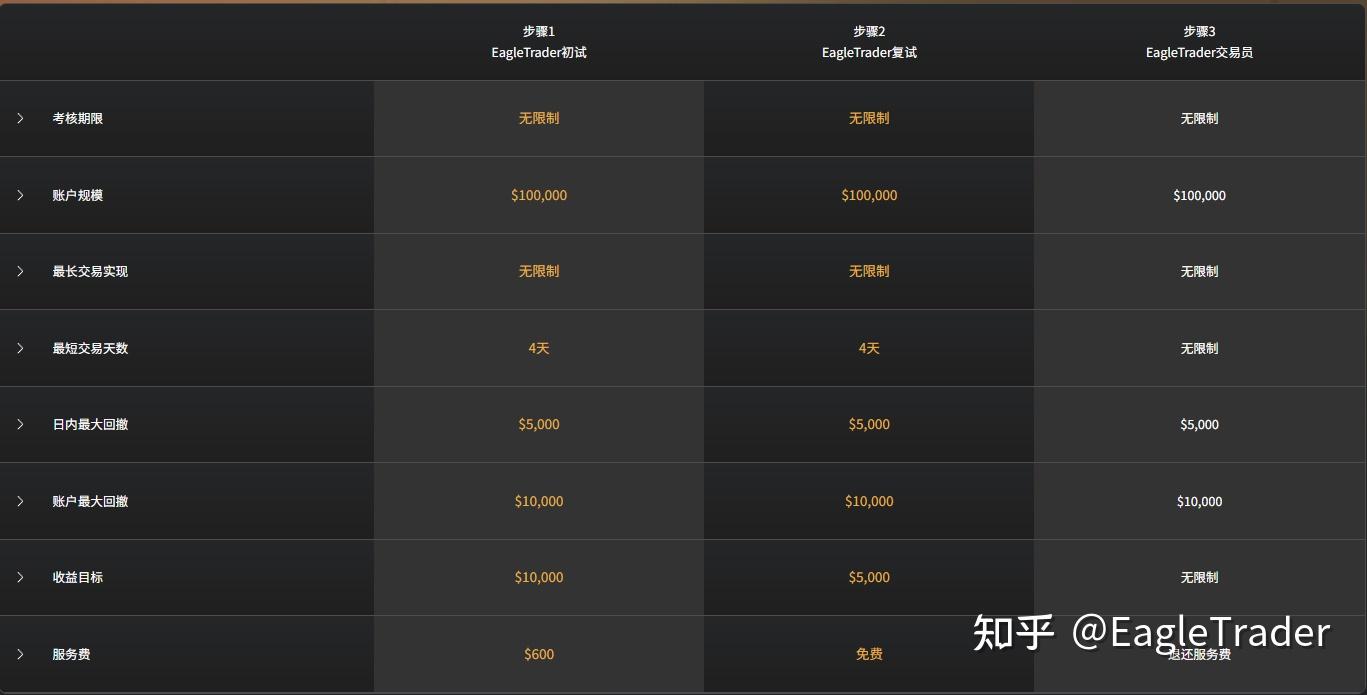
Due to the lack of a fixed completion deadline for the initial test, he decided to slow down and stabilize his account status first.
After the position decreased, he found that his judgment began to become clearer.
Previously, he had gradually developed a trading philosophy that leaned towards a larger trend, but after entering the assessment, he also found that there were certain compatibility issues between the original trading methods and account rules.
At the interview, he began to actively adjust his trading pace, shifting from larger trend trading to band trading, while reducing trading frequency, hoping to make the strategy more in line with account rules.
For him, this is not simply a change in trading method, but a re examination of his strategic boundaries.
As for how to adjust next, he didn't set himself very aggressive goals.
I haven't considered the future for now. Let's stabilize for a few months and then slowly polish. There isn't so much or so fast progress, let's take it step by step
03 | Don't rely on luck, put consistency into the trading system
In Ren Jianxu's trading philosophy, luck does not play a very important role.
I never expected any luck, just based on the system and my own efforts
Occasionally stopping losses just before the market starts or continuing to move in the same direction after closing positions, in his opinion, are normal occurrences in trading.
A transaction may have randomness, but after extending the cycle, he is more concerned about whether his behavior can remain consistent.
As long as the cycle is extended, what can be stably sustained is definitely consistency
His understanding of consistency is not about mechanically repeating the same operation, but about having a clear plan before each entry, knowing when to continue and when to exit after opening the warehouse, and not easily changing the original execution standards just because of one or two gains or losses.
In terms of trading methods, he currently leans towards right-hand trading and does not deliberately pursue bottom fishing and top fishing.
When making judgments, key positions and entry opportunities will be identified based on major cycles, trends, supply and demand relationships, and macro backgrounds.
He prefers to only focus on the parts that he can understand and execute rather than trying to capture the entirety of a market trend.
After using it for three years, he finally quit "losing money and adding positions"
When it comes to the handling of positions after losses, Ren Jianxu's attitude is very clear: "Since I have incurred losses, it proves that I was wrong from the beginning. Why do I still incur losses and add positions
But it took him a long time to truly achieve this principle.
In the first three years of trading, adding positions at a loss was a recurring issue for him.
After experiencing multiple instances of account loss, he gradually removed this operation from his system.
Now, he only considers adding positions in a profitable state, and the conditions for adding positions will be stricter than the first entry. By adding inventory, profits can double, and even if you lose money, you won't be in a dilemma
For risk, he also established his own quantitative method.
If we consider the acceptable overall risk as 100 points, then only a portion of it is used on average per transaction, and even if there is enough risk space, it will not be fully utilized.
When there is a certain degree of continuous loss, he will take the initiative to stop and re-examine his mentality, cognition, and execution, rather than continuing to increase trading frequency.
This is also one of the biggest differences between him and the early trading state.
In the past, when there were losses, his first thought was how to make the money back as soon as possible; Now, he will first determine whether this loss is a normal fluctuation of the strategy or if his judgment, emotions, or execution have gone wrong.
05 | Assessment brings him more than just a result
Ren Jianxu said that one of the biggest gains after participating in the EagleTrader assessment was to re polish his trading philosophy and system.
The initial test showed him the mismatch between the original trading rhythm and account rules, while the interview prompted him to readjust his strategy. Throughout the process, the requirements for risk and consistency also led him to re-examine many of his habitual trading habits.
He compared the market to spring, summer, autumn, and winter. There may be sunny days, rainy days, windy days, and possibly hail.
What traders can do is not to demand that the market always conforms to their preferences, but to understand what they are good at and suitable for, and then gradually form a set of methods that can be executed in the long run.
I don't like it or not, I just adapt to the market
In his five years of trading experience, Ren Jianxu did not find an answer that made trading suddenly easier.
What really changes are actually some very specific things: no longer losing money and increasing positions, and starting to actively control positions; Stop demanding daily trading and learn to wait for opportunities;
We no longer place too much emphasis on a single profit or loss, but gradually shift our attention to execution and consistency over longer periods.
The process from repeatedly liquidating positions to gradually establishing one's own trading system is not fast. As he said:
Let's take it step by step
This sentence may also be the most fitting summary of his five-year trading experience.
Ready to take on EagleTrader Max?
No upfront evaluation stage. Trade immediately once funded, with up to 90% profit split.