If you always give back your profits after making them, beware of this psychological trap

When the account has an unrealized profit of $8,000, you stare at the screen and a thought may appear: I've already made so much, it should be fine to loosen up a little.
So a trade that you would normally take with 1 lot becomes 3 lots.
The market then pulls back.
Faced with a loss, you do not cut it in time as you usually would, because there is still the profit you made earlier in the account.
By the time you realize the risk has exceeded the plan, the original unrealized profit may have been given back substantially and may even be approaching the account's risk-control line.
If you have experienced a similar moment, the problem may not lie in your technique, or even in your discipline—it may be that your brain is doing something you are not aware of.
The invisible ledger in your brain

Nobel Prize-winning economist Richard Thaler proposed in the 1980s a concept that later deeply influenced behavioral finance: mental accounting.
It describes a common phenomenon: people mentally divide money into different accounts according to its source, purpose, and how it was obtained, and adopt different attitudes toward them.
The same 10,000 yuan—whether received as a year-end bonus or accumulated through long-term savings—may feel completely different psychologically when being spent.
From an economic value perspective, they are both 10,000 yuan; once they enter a person's decision-making system, however, they may be assigned different meanings.
Similar situations can also occur in trading accounts.
When an account starts to profit, the brain easily separates the profitable portion from the initial capital psychologically.
Money already earned will gradually be seen as a buffer that can withstand more risk.

In a 1990 study, Thaler and Johnson summarized a similar phenomenon as the House Money Effect: after people have just gained a profit, their acceptance of subsequent risk may increase, because the earlier gains psychologically reduce the pain of losing again.
In trading, this change may manifest very concretely.
Position sizes that were originally fixed begin to increase, stop-loss ranges widen, trading frequency rises, and some trades that would not normally be executed begin to enter the account.
The strategy has not changed, and the market may not have fundamentally changed; what has changed is the trader's psychological definition of the account's funds.
After making a profit, risk standards may also quietly change
A very typical manifestation of mental accounting in trading is that traders adopt different risk standards for principal and profit.
When an account is just starting, position size, stop-loss, and per-trade risk usually have clear plans; but once the account has accumulated some profit, the original boundaries tend to loosen gradually.
Position sizes that would previously have been unacceptable begin to feel worth trying; at a level where a stop-loss should have been taken, you may wait a little longer because there is still profit.
That is where the problem lies.
From the perspective of trading results, both the principal and profit in an account will ultimately be reflected on the same equity curve.
Once profit enters the account, it also needs to be included in risk management, rather than becoming an extra risk budget.
The dynamic drawdown rules of EagleTrader Max make this very intuitive.
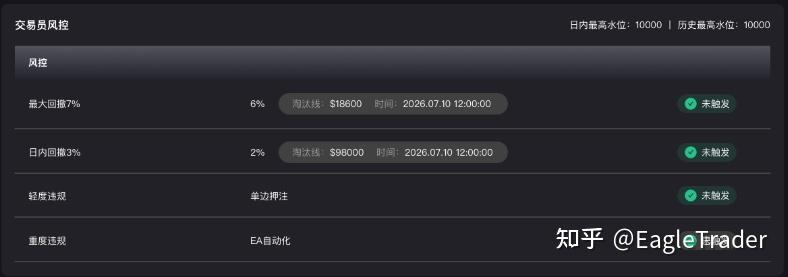
Max sets a maximum drawdown of 7% and a maximum daily drawdown of 3%; both risk-control lines move with the account's high-water mark.
The maximum drawdown risk-control line is calculated as historical high-water mark minus initial account size × 7%.
For example, for a $100,000 account, when the historical high-water mark reaches $109,000, the maximum drawdown risk-control line moves up accordingly to $102,000.
This means that after the account creates new profit, the risk boundary will also change accordingly.
The $9,000 earned earlier will not therefore all become space that can take on risk again.
The intraday 3% dynamic drawdown follows similar logic.
After the account's equity reaches a new high during the day, the intraday risk-control line will also adjust accordingly.
Therefore, having made a profit in the morning does not mean that you can correspondingly increase position size or raise trading frequency in the afternoon.
The two rules correspond to different time scales: 7% concerns the entire account cycle, while 3% concerns a single trading day, but together they point to the same question—after the account makes a profit, can the trader still maintain the original risk standards?
This is also where mental accounting most easily affects trading decisions.
In many cases, the strategy has not changed, and the market has not required the trader to increase risk; it is simply that because the account has made money, the person's acceptance of the same loss has changed.
Rules will not eliminate this psychological tendency, but they can draw a clear boundary for risk.
For traders who have already formed a mature trading system, what truly needs to be maintained is that whether the account is in profit or drawdown, position size, stop-loss, and risk budget are still built on the same logic.
Let's return to the $8,000 unrealized profit at the beginning of the article.
If this portion of the profit had not materialized, you probably would not have suddenly increased from 1 lot to 3 lots, nor would you have been willing to let a trade that should have been stopped out continue running.
So what changes your decisions is not necessarily the market, but could also be the way you manage your capital.
Ready to take on EagleTrader Max?
No upfront evaluation stage. Trade immediately once funded, with up to 90% profit split.