Why Are Range-Bound Markets More Important Than You Think? Decoding the Trading Opportunities Behind Sideways Price Action

Every strategy has its highlight period and its weak period.
There are already many articles on trend trading, but the market is never only about trends.
One day, every market will stop moving in one direction and shift into sideways consolidation.
When this happens, trend traders usually have only two choices: wait patiently, or adapt proactively.
In this article, EagleTrader will explore the second option: how to identify a ranging market, and which strategies can help you navigate it with discipline!
What is a ranging market?
A ranging market (also called range-bound conditions) refers to prices moving back and forth between two horizontal levels, rather than showing a one-way rise or fall:
Support: the price zone below, where buying pressure usually enters and pushes prices up.
Resistance: the price zone above, where selling pressure usually enters and pushes prices down.
Price will bounce back and forth between these zones until bulls or bears eventually break the balance and achieve a breakout.
Why ranging markets are more important than you think
According to statistics, the market is in a range about 70% of the time, while trending markets account for only about 30%.
Moreover, the vast majority of traders cannot capture an entire trend at all.
If your strategy only works in trending markets, then for most of the market life cycle, you can only stand on the sidelines.
Ranges usually form at:
End of a trend: the market pauses briefly before reversing.
Beginning of a new trend: a hesitation period while the market is searching for direction.
Inside a longer-term trend: price enters a larger-degree consolidation phase.
Being able to trade these ranging phases means you can get more trading opportunities without having to rely solely on a single market state.
Strategy 1: Trade ranges between support and resistance
Range Trading is the most direct way to handle a ranging market.
Its logic is very simple:
Go long when price rebounds from support; go short when price is rejected at resistance; place your stop loss outside the range beyond your entry; set your take profit on the other side of the range. Why it works: clear price levels and a clear risk-reward ratio
Range trading's biggest advantage is clarity. Your entry point, exit point, and risk are all determined by the chart itself, making it easier to plan a reasonable risk-reward ratio (RRR) before opening a position.
Treat price levels as 'zones', not single prices: support and resistance are never one precise point, but a zone.
Give your stop loss enough room to avoid being taken out by normal market noise, and adjust your position size accordingly.
Use internal ranges to take partial profits: on a higher timeframe chart, a large range often contains smaller swings, each with its own support and resistance.
These internal levels are good places to take partial profits along the way.
Strategy 2: Trade breakouts
Ranges do not last forever. When price finally breaks through support or resistance, it often signals: the start of a new trend, or the continuation of a trend that was previously consolidating.
This makes ranging markets equally valuable to trend traders.
A range provides a clear reference point for your stop loss; if the subsequent breakout develops into a long-term trend and you manage to stay with it, the risk-reward ratio of the trade will be very attractive.
Strategy 3: Keep it simple with Price Action
Trading a range does not require a screen full of indicators.
Pure price action works very well here, because the core information is already displayed directly on the chart: where price reacts and where it is rejected.
Oscillators can help you capture overbought or oversold conditions at the edges of a range.
However, trend indicators such as moving averages have limited value in ranging markets and may even give misleading signals.
Practical case: the 2020 EURUSD range
In early April 2020, EURUSD formed a ranging zone that lasted until the end of May.
During this period, the currency pair provided multiple trading opportunities in both directions.
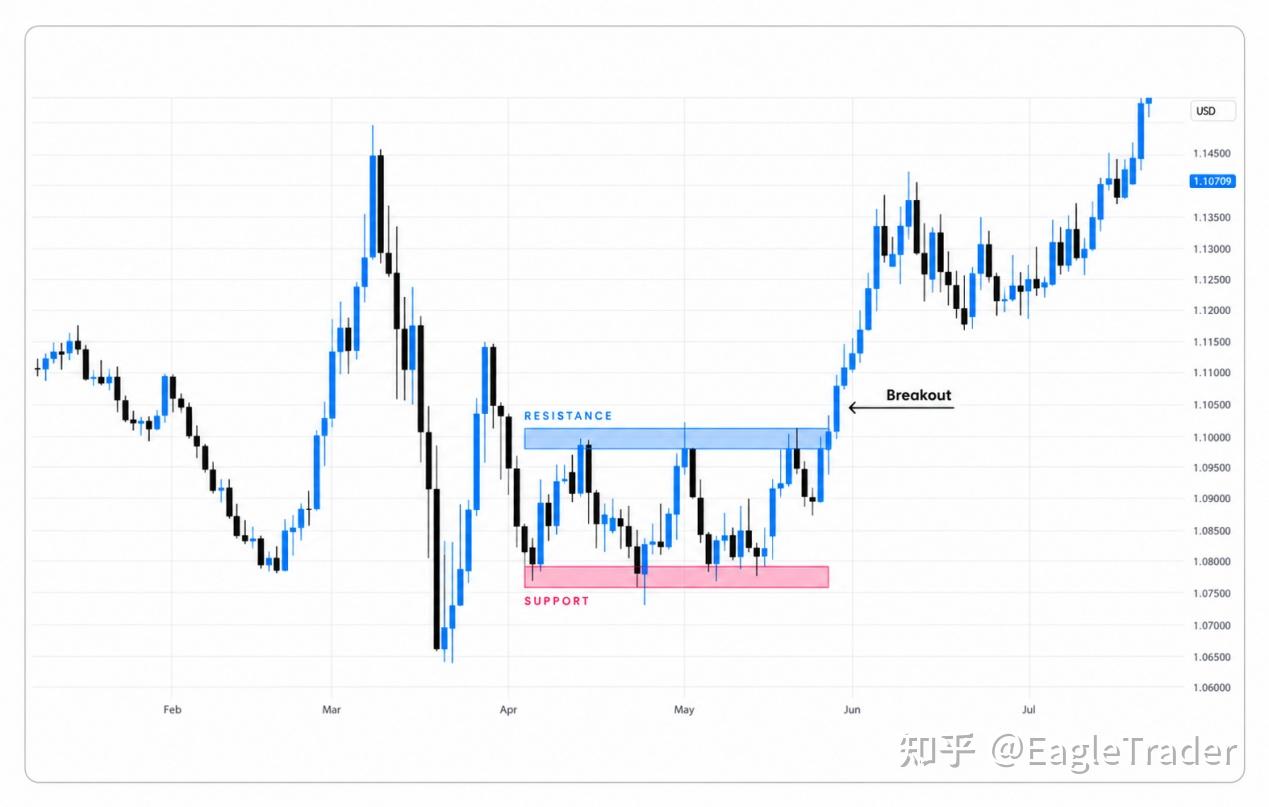
After breaking through resistance, the market developed a strong trend that lasted until the end of 2020, accompanied by a longer consolidation (and another tradable range).
In this case, the April-to-May range was not only an early signal of a trend reversal but also incubated a completely new picture of trend-trading opportunities.
Range-bound markets are not periods when you must choose to “sit on the sidelines.”
Range trading can provide you with clear price levels and a clear risk-to-reward ratio, while the breakout that ends the range may mark the starting point of the next trend.
However, be sure to watch out for false breakouts: patiently wait for confirmation signals, leave room for stop-losses, and maintain consistency in risk. When the market stops trending in one direction, discipline is the key to keeping you in the game.
Ready to take on EagleTrader Max?
No upfront evaluation stage. Trade immediately once funded, with up to 90% profit split.