4 'Getting Carried Away' Moments for Traders—How Many Have You Had?
The most dangerous moments in trading are often not the losses themselves, but those moments when you feel you’re “in great form.”
Many people mistakenly believe that mature traders have no emotions at all.
However, a 2026 study in “Modern Finance” gives a different conclusion: even for traders with a rational-analytical style, emotions still occupy a core position in decision-making, so the gap between traders is not about eliminating emotions, but about being able to identify them in time.
But the most terrifying effect of emotions is not when you lose control, but when they disguise themselves as “rational judgment.”
Here are four moments of “getting carried away”—see whether you’ve ever been caught by any of them.
1. After a loss, you can’t wait to “make it back.”
A trade exits at a stop loss, and your account equity suffers a drawdown.
You stare at the screen, fingers hovering over the keyboard—not because you’ve spotted a new signal, but because your mind keeps replaying the loss you just took.
This is the starting point of revenge trading.
It is driven by frustration and unwillingness to accept the loss; at its core is the hope of quickly recovering losses through high-risk trades.
Recency bias magnifies the weight of this loss, letting a single failure outweigh the statistical results of dozens of previous trades.
And revenge trading turns this cognitive imbalance into action: you rush into the market again, often with a larger position and a more hurried stop loss, making it easier to be swept out by the market directly.
Related research describes the cycle this way: every emotionally driven entry creates a piece of “evidence” for the brain to rationalize itself, making you feel the next trade has even more reason to correct the loss.
Your account is shrinking, while the emotional cost is rising.
2. After several wins in a row, you feel you “understand the market.”
Few traders notice the risks hidden behind consecutive profits.
Most people know that losses can interfere with judgment, but they often overlook the mindset changes brought by consecutive profits.
A string of profits can create an illusion: that your understanding of the market has become clearer.
What follows is larger position sizes, higher frequency, and looser entry conditions; your original risk limits begin to look “too conservative.”
But this shift does not appear in the form of “I am overconfident now”; instead, it disguises itself as reasonable self-perception: “I’m really in good form today” and “this opportunity is especially clear.”
Consecutive profits may come from high-quality execution, or they may simply mean that the short-term market happens to align with your direction.
The former can be replicated; the latter cannot.
3. Seeing others making money while you are flat.
You had originally made a clear plan not to open a position that day.
But when you scroll past someone else’s profit screenshot, or see a certain instrument surge quickly while you are not in it, you find it hard to resist.
What drives you is not entirely greed, but a more primitive psychology: the anxiety of missing out.
FOMO has a very specific definition in trading: an urge to open a position not based on objective signals but purely out of fear of missing a market move.
Social comparison plays a key role here—multiple psychological experiments have confirmed that the anxiety of watching others profit can sometimes be harder to bear than suffering losses yourself.
The hardest part of FOMO to guard against is that it makes you mistake chasing a move that has already gone a long way for seizing an opportunity.
4. When the day is going smoothly, you “just do a couple more trades” in the afternoon.
Several trades in the morning all paid off, and your account has already built up a decent floating profit.
By the afternoon, you see another opportunity that is “about good enough to participate in.”
A signal that originally required two or three confirmations before entry now has its standard loosened to “about good enough”;
You had already completed the day’s plan, but a thought pops into your mind: I’m in good form, so I can do a couple more trades.
What often changes is not the strategy, but the trading frequency.
This change is hard to notice in the moment—your account may even still be profitable—but it exposes a core problem: you are using the morning’s results to psychologically endorse the additional risk taken in the afternoon.
The profits earned in the morning are treated in your mental accounting as risk-taking chips that can be spent freely.
These four ways of “getting carried away” have one common solution.
Revenge trading, overconfidence after profits, FOMO, and blindly increasing frequency when the market is going smoothly—these four states look completely different on the surface, but their underlying logic is highly consistent: using the most recent trading results to replace an objective calculation of current risk.
Every time, you are using “what just happened” to decide “what to do next.”
But from a probability perspective, recent results have no direct bearing on whether the next trade should be taken or how large it should be.
Since the problem is that “recent results” interfere with judgment, the solution is clear: remove recent results from the decision-making chain.
The rule system of EagleTrader Max is designed to do exactly this.
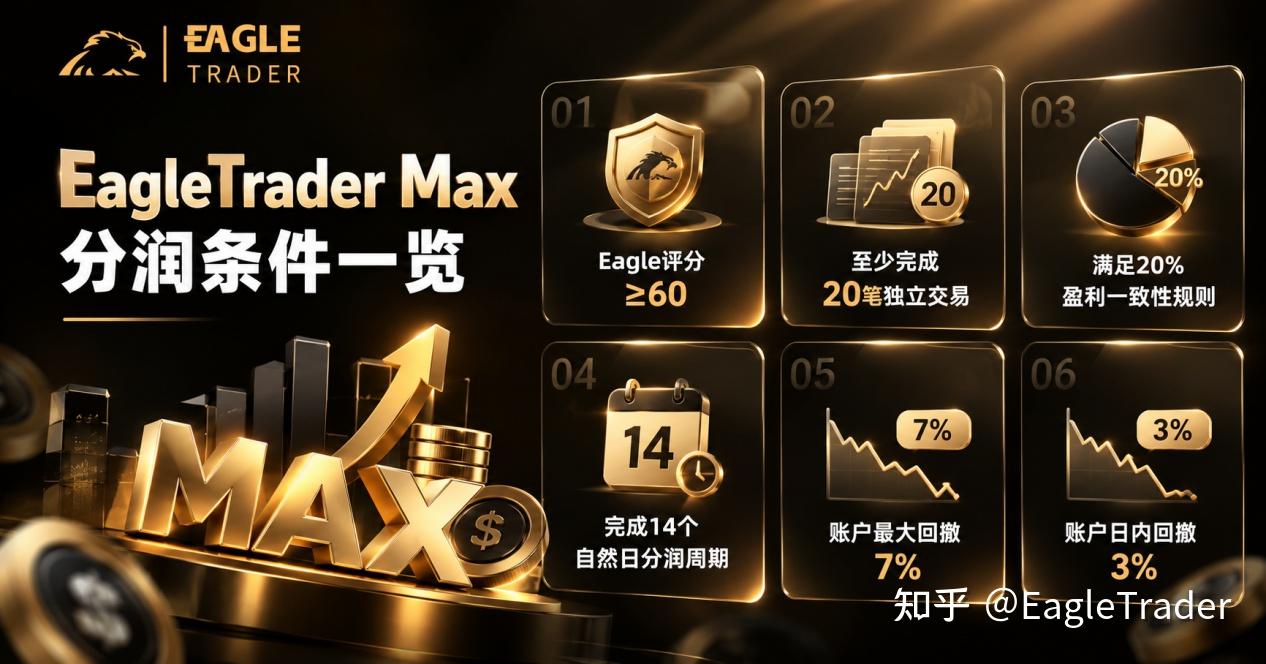
The 7% total drawdown is anchored to the historical high-water mark; whether you have just lost a trade or won several in a row, the risk-control line only follows the account peak;
The 3% intraday drawdown is anchored to the day’s high-water mark; no matter how much you earn in the morning, your risk budget for the afternoon will not expand because of it;
The Profit Consistency Rule checks whether returns are evenly distributed across multiple trades, rather than concentrated in one day’s standout performance.
It does not decide for you whether “this trade should be taken”; it only tells you one fact: starting from the account peak, how much risk space you have left.
This space will not grow because you “want to win it back,” nor will it grow because you are “in good form.”
It depends only on the account’s own trajectory.
Of course, rules can constrain behavior, but they cannot eliminate impulses at the root.
Risk control is the external last line of defense; the true first barrier against emotional trading always comes from the trader’s own emotional awareness.
But if you find yourself repeatedly making mistakes at four kinds of “getting carried away” moments, then a risk-control red line can at least give you one more reason to stop when you are impulsive.
Ready to take on EagleTrader Max?
No upfront evaluation stage. Trade immediately once funded, with up to 90% profit split.