当过去的交易经历开始影响下一笔交易时,真正的风控应该怎么做?

After a trader took a heavy position and was stopped out in 2023, over the next two years, every time he encountered a similar opportunity, he would subconsciously reduce his position size.
It was not his strategy that required him to do so, nor was there any data supporting the judgment that "this time will also lose."
But his hand simply would not dare to pull the trigger.
Another trader caught a major market move in 2022.
Afterward, whenever the market showed a similar signal, he was more aggressive than usual — larger positions, earlier entries, and wider stop losses.
On the surface, one is conservative and the other aggressive, but they are doing the same thing: letting a certain past experience place orders for their present selves.
And they may not realize it.
Memory is secretly rewriting your risk appetite
In 2024, NBER published a study based on real trading data from 17,000 Chinese retail investors.
The researchers found that investors do not make decisions based on all historical experience, but form expectations based on "recalled experiences."

More importantly, these recalled experiences even have greater explanatory power for expectations than the actual experiences themselves.
On days when the market rises, investors are more likely to recall moments when they made money before, and thus become more optimistic about the future; on days when the market falls, loss memories are retrieved, and expectations turn bearish.
Laboratory research also found a similar direction: having participants recall their profitable trades before investing made their subsequent bets more aggressive; while the inhibitory effect brought by recalling loss episodes was far less symmetrical than imagined.
This shows that the brain is not "objectively referring to past experience."
It is prompted by the current market and emotions to selectively pull out a certain memory, and then use that memory to redefine how you feel about risk.
You think you are making a judgment, but in fact the current market has chosen for you which past to recall.
It will disguise itself as two judgments that look very "reasonable"
Memory bias does not appear in the form of "I am being influenced by memory."
It puts on the cloak of analysis.
The first type: "there is an opportunity this time" after making a profit.
You once made a big profit with a heavy position in a certain type of market, and that experience was marked by the brain as a success template.
Later, when encountering a similar signal, the brain automatically retrieves this memory and makes you feel "there is an opportunity this time too."
Position size quietly expands, and stop loss quietly widens. You think you are reviewing your trades, but you are actually just replaying a recording.
At such times, the mistake people are most likely to make is not failing to make money, but returning the profit just pocketed together with the principal — because when things are going well, people truly believe "the feel is here," and the profit on the books is never yours before you exit.
The second type: "wait a little longer" after a loss.
You once had an experience where you did not exit a floating loss, and the market eventually came back.
This memory was marked by the brain as "patience works."
Afterward, every time there was a floating loss, the same voice would pop up: "Hold on a little longer, didn't it come back last time?" Support levels, resistance levels, fundamentals — you can find reasons for all of them, but what really keeps you from acting is that old experience.
And one stubborn hold can often wipe out the previous ten small profits.
Because when you are in a floating loss, you can always find a reason not to cut, but the market will not give you another chance just because "you held on and it came back last time."
Why relying on yourself to watch it doesn't work
The problem is that in both states, you genuinely believe you are right.
When things go well, you truly believe "this time is different"; when you are losing, you truly believe "hold on a little longer and it will come back."
Letting the person affected by memory judge whether he is affected by memory — this itself is unreliable.
So what you need is not "more effortful awareness," but a risk-control line that you set in advance, execute when it is reached, and leave you no room to bargain.
What EagleTrader Max does is front-load risk control into an account-level hard constraint.
It does not care what you are thinking at this moment; it only recognizes the numbers set in advance.
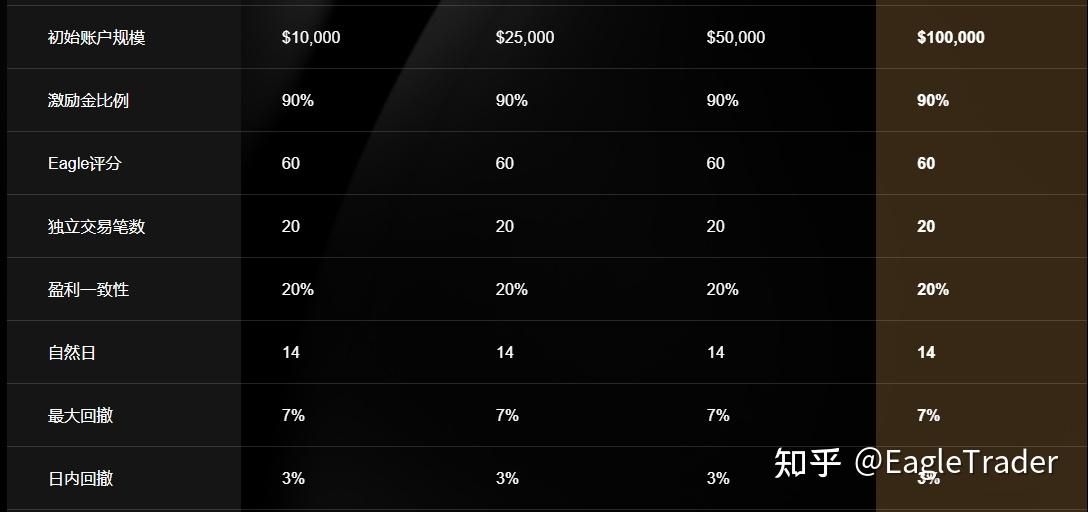
For "increasing position size after making a profit," it uses a maximum drawdown line based on the historical high-water mark — 7%, which only rises and never falls.
If the account grows from 100,000 to 109,000, the drawdown line moves up from 93,000 to 101,300 accordingly.
The newly earned 9,000 is no longer your capital for losses.
You did well, and the line follows you; if you want to increase risk because of successful experiences in your memory, this line will not give you even one millimeter of extra room.
For "holding on stubbornly after a loss," it uses an intraday drawdown line based on the day's highest water mark—3%, reset every trading day.
If you do well in the morning, the afternoon line will not loosen just because "you've already made money today."
It doesn't care which memory you're replaying in your head; it recognizes only one number: how much room you have left from today's highest point.
When you reach the line, you leave—the option to "wait a little longer" does not exist at the system level.
It also looks one layer deeper: it checks whether your profits are distributed across multiple repeatable trades or concentrated in a few heavy-position bets. This is the role of "profit consistency" in the Max profit-sharing conditions.
This psychology is essentially the brain amplifying those impressive experiences and using them to quickly judge the risks in front of it.
To change it, the key is not to force yourself to forget the past, but to bring every trade back to the strategy, probability, and risk rules themselves.
And risk control mechanisms like EagleTrader Max can fix part of the risk boundary in advance, reducing the interference of emotions and past experiences with execution.
The past can become experience, but it should not become the decider of the next trade.
Ready to take on EagleTrader Max?
No upfront evaluation stage. Trade immediately once funded, with up to 90% profit split.